About The Author: Travis Baugh is a Digital Brand Marketing Manager for Bryant, where he creates clear, helpful content to guide homeowners through heating, cooling, and indoor air quality decisions. His goal is to empower readers with the knowledge they need to choose the right comfort solutions for their home—confidently and comfortably.
What Is A Ductless Air Conditioner?
A ductless air conditioner, also known as a mini split, is a high-efficiency cooling system that delivers temperature-controlled air directly into specific zones of your home without requiring ductwork. By pairing an outdoor compressor with one or more indoor air-handling units, these systems offer a flexible, energy-saving alternative to traditional central air.
For homeowners seeking long-term comfort and efficiency, ductless technology represents a leap forward in residential climate control. Whether you are outfitting a new addition, renovating an older home, or simply want to eliminate the energy loss associated with leaky ducts, a ductless mini split system offers unparalleled precision.
How Does A Ductless Air Conditioner Work?
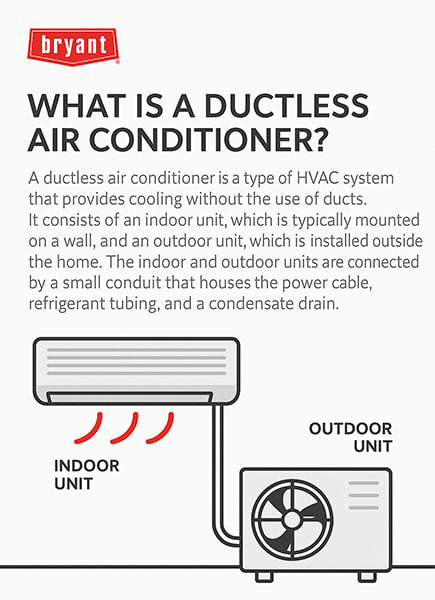
A ductless air conditioner operates by cycling refrigerant between an indoor unit and an outdoor compressor to absorb heat from your home and release it outside.
The process is efficient and seamless:
- Heat Absorption: The indoor unit, mounted on a wall or ceiling, uses an evaporator coil to absorb heat from the room's air.
- Transfer: The refrigerant carries this heat through a small, insulated line to the outdoor unit.
- Release: The outdoor compressor pressurizes the refrigerant, releasing the trapped heat into the outside air.
- Cooling: The cooled refrigerant returns to the indoor unit to repeat the cycle, lowering the room temperature.
Brian Redmond, owner of Redmond’s Complete Comfort in Lock Haven, Pennsylvania, often describes ductless air conditioners as “spot conditioning” systems.
“The best way to explain a ductless mini-split system is that it’s a spot conditioning system, giving homeowners the ability to condition individual rooms with individual control,” Redmond said. “They’re also much more energy efficient than central units because you can run them room by room instead of conditioning the entire home.”
Key Benefits of Ductless Systems
Why are homeowners switching to ductless? The answer lies in the combination of advanced technology, energy savings, and superior comfort.
- Energy Efficiency: Traditional systems can lose significant energy through duct leaks. Ductless units bypass this issue entirely, delivering cool air directly to the source. High-efficiency ratings (SEER2) mean lower monthly utility bills.
- Zoning Capabilities: Create custom comfort zones. You can keep the living room cool while saving energy in unoccupied bedrooms.
- Quiet Operation: Designed for peace and quiet, the noisy compressor sits outside, keeping your indoor environment whisper-quiet.
- Flexible Installation: With no ducts to install, setup is minimally invasive—often requiring just a small hole in the wall. Learn more about mini split installation.
- Smart Home Integration: Many models feature Wi-Fi connectivity, allowing you to control your climate via smartphone or voice assistant.
How to Choose the Right Ductless System
Selecting the best mini split involves balancing technology with your specific home environment.
1. Determine Your Zones
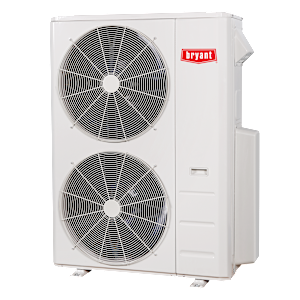
If you need to cool a single room or a home addition, a single-zone unit is ideal. For whole-home comfort, a multi zone mini split allows you to connect multiple indoor units to one outdoor compressor, giving you independent control over every room.
2. Prioritize Efficiency
Look for high SEER2 (Seasonal Energy Efficiency Ratio) and EER2 ratings. Units with inverter technology adjust compressor speed in real-time to maintain consistent temperatures without energy-spiking on/off cycles.
3. Sizing and Placement
Size matters. A unit that is too small won't cool effectively, while one that is too large will cycle frequently, reducing efficiency. Ask, "what size mini split do I need?" and consult a professional to perform a load calculation.
4. Smart Features and Control
Modern comfort puts you in control. Look for systems compatible with the Bryant SmartHome App, enabling remote adjustments and scheduling to maximize efficiency.
5. Cost and Incentives
Ductless systems are an investment in long-term value. While mini split installation costs vary (typically between $2,500 and $11,000 depending on complexity), you can offset these through local rebates. For a precise estimate, check our guide to mini split cost.
Ultimately, Redmond advises leaning on a professional HVAC contractor to recommend the right system.
“A professional can assess which areas of the home need to be conditioned, talk with the homeowner about their comfort needs, and then provide the best options,” Redmond said.

Connect With A Bryant Dealer For A Ductless Air Conditioner
he best way to ensure peak performance is professional installation. A Bryant dealer can assess your home's layout, recommend the right ductless air conditioner and ensure your system is optimized for years of reliable comfort.
Schedule an appointment with a local Bryant dealer today for a seamless, worry-free ductless air conditioner experience.
Explore Bryant Ductless Mini Splits
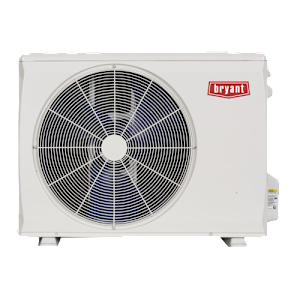
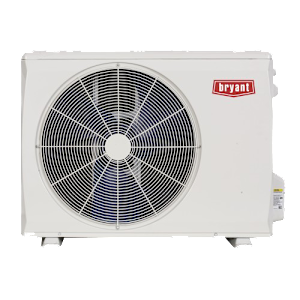
Choose a Bryant ductless mini split for efficient, customizable comfort without the need for ductwork. Ideal for specific rooms or multi-zone cooling and heating, these systems offer precise temperature control and quiet operation. With energy-efficient technology, they help reduce utility costs while providing year-round comfort. The sleek design makes Bryant mini splits a perfect choice for homes, additions, or spaces where traditional ductwork is impractical, delivering reliable performance and convenience.
Ductless Air Conditioner FAQs
No, ductless air conditioners do not require venting because they use a small outdoor unit to transfer heat rather than relying on ductwork.
Ductless AC units are generally energy-efficient, so operating costs are often lower than traditional central AC, especially when cooling individual zones.
A ductless AC circulates refrigerant between an outdoor compressor and one or more indoor air handlers to cool or heat specific rooms without ducts.
For homes without ductwork or rooms that need targeted comfort, ductless systems offer efficient, quiet, and flexible temperature control.
“Mini split” and “ductless system” are often used interchangeably, since both refer to HVAC systems that heat and cool without traditional ductwork. A mini split specifically describes the setup—an outdoor compressor connected to one or more indoor air-handling units—while “ductless” highlights the absence of ducts that distribute air. In practice, both terms describe the same technology.
Learn More About Ductless Mini Splits
- Learn all about what is a mini split
- Discover the value in mini split heat pumps
- Understand what is a ducted mini split
- Find out are mini splits worth it?
- Learn all about mini split vs central air
- Learn the ins and outs of mini split maintenance


