About The Author: Travis Baugh is a Digital Brand Marketing Manager for Bryant, where he creates clear, helpful content to guide homeowners through heating, cooling, and indoor air quality decisions. His goal is to empower readers with the knowledge they need to choose the right comfort solutions for their home—confidently and comfortably.
Garage Air Conditioners: A Guide to Cooling Your Garage
By Travis Baugh
A ductless mini-split system is often the best choice for a garage AC unit. These systems operate independently from your home's main HVAC, providing efficient, zoned cooling and heating without requiring ductwork. This guide will walk you through everything you need to know about choosing the right garage air conditioner.
Why are Ductless Mini-Splits the Best AC for a Garage?
A ductless mini-split system is an excellent option for a garage air conditioner because it operates separately from your home's main HVAC unit. This separation is crucial for both performance and safety.
David Fowler, owner of Family Heating and Air in Pensacola, Florida, explains why mini splits are a great option for garage air conditioners.
“One of the most beneficial things is that the system is separate from your main HVAC unit,” Fowler said. “Typically, your main unit doesn’t have enough capacity to handle a garage, and adding the load can cause it to struggle.
“Another issue people often overlook is safety,” he continued. “Using your main system for the garage can allow carbon monoxide from a car or other device to enter your home. A mini split keeps the spaces separate. Plus, you can turn it on and off as needed, and they’re very efficient.”
Learn more about what is a mini split.
What Should I Consider When Choosing a Garage AC Unit?
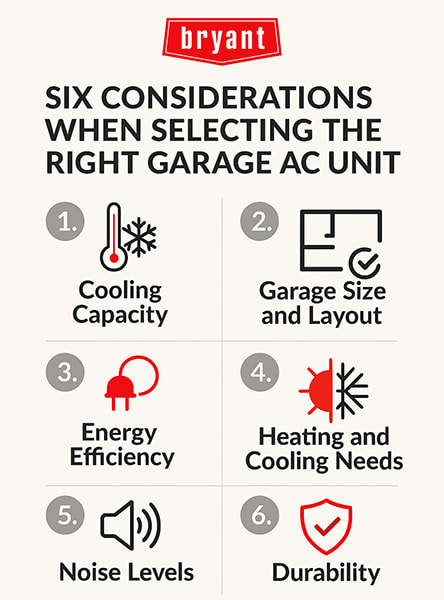
When selecting the right garage AC unit, there are six key factors to consider to ensure you get a system that provides reliable, efficient comfort.
1. Cooling Capacity (BTUs)
First, determine the cooling capacity your garage needs, measured in British thermal units (BTUs). A well-insulated garage may require a smaller unit, while a larger or poorly insulated space will need more power. Work with a Bryant Certified Ductless Pro to calculate the correct BTUs for your space.
2. Energy Efficiency
Look for a garage AC unit with a high SEER2 (Seasonal Energy Efficiency Ratio) and EER2 (Energy Efficiency Ratio) for cooling, and a high HSPF2 (Heating Seasonal Performance Factor) for heating. Higher ratings mean lower energy costs and a smaller environmental footprint.
3. Garage Size and Layout
The size and layout of your garage—whether it's a small, enclosed space or a large, open area—will influence which type of air conditioner is most suitable.
4. Heating and Cooling Needs
If you plan to use your garage year-round as a workshop, gym, or living space, consider a mini-split system that offers both heating and cooling. Many models provide reliable heating even in very cold temperatures.
5. Noise Levels
Choose a garage air conditioner with low noise levels, especially if you spend a lot of time in the space. Bryant systems are designed for quiet operation, ensuring your activities aren't disrupted.
6. Durability
Garages can experience significant temperature fluctuations. Select a durable mini-split designed to withstand these conditions for long-lasting performance and reliability.
How Do I Install a Garage Air Conditioner?
Proper installation is critical for the optimal performance of your garage AC unit. It is highly recommended to hire a professional HVAC technician to install the system correctly and in compliance with local building codes. A professional installation minimizes the risk of malfunctions and the need for future mini split repair .
Learn more about mini split installation.
How Can I Make My Garage AC More Efficient?
To maximize energy efficiency and reduce your cooling costs, implement these tips:
- Insulate your garage: Add insulation to the walls and ceiling to prevent heat transfer and keep cool air inside.
- Use a programmable thermostat: Set temperature schedules with a programmable thermostat to avoid cooling the garage when it’s not in use.
- Seal ductwork: Ensure any ductwork is properly insulated to minimize air leaks.
- Perform regular maintenance: Clean and maintain your garage AC unit regularly to keep it running smoothly.
What Maintenance Does a Garage AC Unit Require?
Proper maintenance is essential to keep your garage air conditioner running efficiently.
- Replace filters regularly: Air filter replacement is crucial for maintaining efficiency. Replace filters at least once every three months to ensure proper airflow.
- Professional mini split maintenance: Have your local Bryant dealer perform annual mini split maintenance to check for refrigerant leaks and ensure all components are working correctly.
Why Choose a Bryant Garage Air Conditioner?
When it comes to finding the perfect air conditioner for your garage, Bryant is the brand you can trust. We offer reliable and efficient cooling solutions that will keep your garage comfortable all year round.
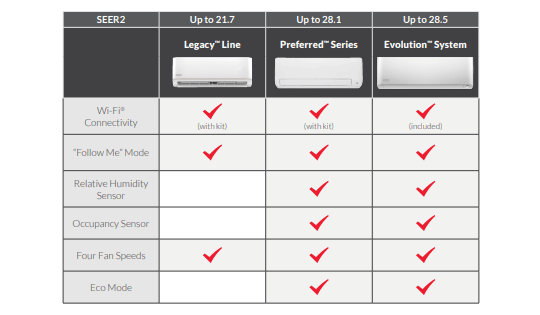
- High Efficiency: With efficiency ratings up to 28.5 SEER2 and ENERGY STAR® certifications on several models, our ductless systems deliver significant energy and cost savings.
- Quality Performance: Our solutions provide year-round comfort, with systems that can heat in temperatures as low as -22° F and cool in temperatures as high as 122° F.
- Cool Innovation: We are constantly innovating to create high-performing ductless solutions that are powerful, quiet, and reliable.

Connect With A Bryant Dealer For Your Garage AC Needs
At Bryant, we offer a range of high-quality garage air conditioners designed to meet your specific needs. Our AC units are known for their durability, energy efficiency, and superior performance. Whether you have a small garage or a large workshop, we have the perfect AC unit to keep you cool and comfortable all year round. Schedule an appointment with your local Bryant dealer and let them determine the best garage mini split for your needs.
FAQs on Garage AC Units
A ductless mini split is often the best AC type for garages because it doesn’t require ductwork and provides efficient, zoned cooling.
The most effective way to cool a garage is by installing a ductless mini split system, paired with proper insulation to maintain temperature.
Yes, you can install an AC unit in your garage, but it’s important to choose a model suited for non-living spaces and ensure the garage is well-insulated for efficiency.
A standard 2-car garage (about 400–600 sq ft) typically requires 9,000 to 18,000 BTUs, depending on insulation, ceiling height, and regional climate.
Yes—if you use the space for work, storage, or hobbies. A properly sized ductless or wall-mounted unit can keep the garage comfortable year-round.
Installing AC in a garage typically costs $3,000 to $8,000, depending on system type, insulation, and whether electrical work or ventilation upgrades are needed.
Learn More About Air Conditioners
- Discover the value in mini split heat pumps
- Read our guide to mini split cost
- Find out are mini splits worth it?
- Learn all about mini split vs central air
- Understand do mini splits turn off when temperature is reached?